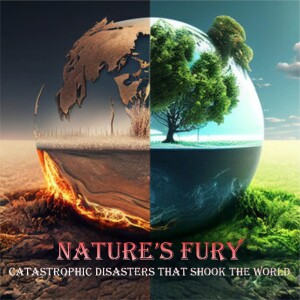
Nature’s Fury: Catastrophic Disasters that Shook the World
This podcast explores the most devastating natural disasters in human history, delving into how these catastrophic events reshaped the world. Each episode presents a deep dive into specific disasters, examining their causes, the immense destruction they caused, and the emotional and social aftermath. Listeners will experience a blend of factual storytelling and powerful, heart-wrenching human experiences to better understand the terrifying power of nature.




Episodes
Jul 22, 2025
Jul 22, 2025
5 min
In August 2017, Hurricane Harvey devastated southeastern Texas in one of the most catastrophic natural disasters in U.S. history. Making landfall as a Category 4 storm, Harvey stalled over the region, unleashing over 50 inches of rain and flooding much of Houston. Streets became rivers, homes disappeared under water, and more than 30,000 people were displaced, with at least 107 lives lost.
This episode explores the storm’s slow-moving destruction, the heroism of local residents and volunteers like the “Cajun Navy,” and the overwhelming humanitarian crisis that followed. We dive into the city’s vulnerabilities—unchecked urban development, inadequate drainage systems—and how climate change likely intensified the storm’s effects.
Hurricane Harvey exposed weaknesses, but it also revealed incredible unity, resilience, and compassion. It wasn’t just a weather event—it was a reckoning for how cities prepare for a future shaped by increasingly extreme natural disasters.
Jul 11, 2025
Jul 11, 2025
5 min
The 1931 Yellow River Flood was the deadliest natural disaster in human history, killing an estimated 2 to 4 million people. Triggered by extreme weather—including snowmelt, cyclones, and torrential rains—the flood overwhelmed the Yellow, Yangtze, and Huai rivers, submerging an area larger than England and affecting eleven provinces in China.
The initial drowning toll was devastating, but the disaster's true horror unfolded in the months that followed. Famine, disease, and displacement claimed millions more lives. Entire villages were wiped out, and survivors endured starvation, disease outbreaks, and hopeless conditions in overcrowded refugee camps.
Despite its scale, the tragedy remains little known outside China due to limited documentation, political instability, and shifting global attention. This episode sheds light on the immense human cost of environmental mismanagement and unpreparedness—an enduring reminder of nature's silent, creeping devastation.
Jun 30, 2025
Jun 30, 2025
4 min
In April 2011, the United States experienced the largest and deadliest tornado outbreak in modern history. Known as the 2011 Super Outbreak, it produced over 360 tornadoes across 21 states over four days, claiming the lives of more than 320 people. April 27 was the most catastrophic single day, with over 200 tornadoes—including multiple EF-4 and EF-5 storms—devastating communities, particularly in Alabama, where Tuscaloosa and Hackleburg were hit hardest.
Jun 18, 2025
Jun 18, 2025
4 min
On May 12, 2008, a massive 7.9 magnitude earthquake struck China’s Sichuan Province, killing nearly 90,000 people and injuring hundreds of thousands more. The quake reduced entire towns to rubble, triggered deadly landslides, and caused widespread infrastructure collapse. The destruction of poorly built schools, which led to the deaths of thousands of children, sparked national grief and public outrage.
May 31, 2025
May 31, 2025
4 min
In this episode of Nature’s Fury: Catastrophic Disasters that Shook the World, we explore the devastating eruption of Iceland’s Laki volcano in 1783—an eight-month-long environmental catastrophe that released poisonous gases and lava on an unprecedented scale. The eruption led to the deaths of a quarter of Iceland’s population, wiped out half its livestock, and created a toxic haze that drifted across Europe, Asia, and Africa.
May 24, 2025
May 24, 2025
4 min
In February 1972, Iran was struck by one of the most extreme and deadliest snowstorms in recorded history. Over the course of just a few days, up to 26 feet of snow fell across parts of the country, burying villages, isolating towns, and severing all forms of communication and aid. Entire communities—such as the village of Kakan—were wiped off the map, with no survivors.
May 6, 2025
May 6, 2025
4 min
In the early hours of July 28, 1976, the city of Tangshan in northeastern China was struck by a devastating 7.5 magnitude earthquake. In just 23 seconds, the industrial city was reduced to rubble. Over 240,000 lives were officially lost, and more than 160,000 were injured—making it the deadliest earthquake of the 20th century.
Apr 16, 2025
Apr 16, 2025
5 min
Typhoon Haiyan—locally known as Yolanda—struck the Philippines in November 2013 as one of the strongest tropical cyclones ever recorded, with wind speeds reaching up to 195 miles per hour. This unprecedented storm tore across the Visayas region, making multiple landfalls and generating storm surges over 20 feet high. Entire cities like Tacloban were devastated within hours, as powerful winds and waves leveled buildings and swept away homes.
Mar 30, 2025
Mar 30, 2025
4 min
The Chernobyl disaster of April 26, 1986, was the worst nuclear accident in history, releasing a massive amount of radioactive material into the environment. It occurred during a safety test gone wrong at Reactor 4 of the Chernobyl Nuclear Power Plant in Pripyat, Ukraine. A power surge triggered explosions, blowing off the reactor’s 1,000-ton lid and spewing radiation into the air.
First responders, unaware of the radiation, fought the fires without protection, leading to acute radiation sickness and death within weeks. The nearby town of Pripyat remained oblivious for 36 hours before a sudden evacuation order forced 49,000 residents to abandon their homes forever. The Soviet government attempted to hide the scale of the disaster, but when radioactive clouds reached Sweden, the truth emerged.
Over 600,000 “Liquidators” were sent to contain the fallout, building a concrete sarcophagus around the reactor. Many suffered from cancers, organ failure, and radiation poisoning. Even today, the Chernobyl Exclusion Zone remains uninhabitable, a ghostland overtaken by nature.
Chernobyl’s legacy is one of devastation and lessons learned. It exposed flaws in Soviet secrecy, influenced global nuclear safety reforms, and contributed to the fall of the Soviet Union. Yet, its haunting ruins remind us of the unseen dangers of nuclear power and the long-term consequences of human error.
Mar 16, 2025
Mar 16, 2025
5 min
The 1883 eruption of Krakatoa was one of the most violent volcanic events in recorded history. Located between Java and Sumatra, the volcano had been showing signs of activity for months before culminating in a series of catastrophic explosions on August 26-27, 1883. The final blast at 10:41 AM was so powerful that it was heard over 3,000 miles away, making it the loudest recorded sound in history.
The eruption caused the complete collapse of the central island, triggering massive tsunamis over 100 feet high, which devastated coastal communities and killed more than 36,000 people. Ash and debris were ejected into the upper atmosphere, darkening skies and causing vivid red sunsets worldwide. The global temperature dropped by 1.2°F (0.7°C) for years due to the volcanic dust blocking sunlight, leading to climate disruptions and food shortages.
Survivors described an apocalyptic scene of blackened skies, suffocating ash, and roaring seas. Entire villages were wiped from the map, and bodies continued washing ashore weeks later. The eruption reshaped the landscape, but volcanic activity returned in 1927, giving birth to Anak Krakatau, or “Child of Krakatoa,” which continues to erupt today.
The 1883 Krakatoa disaster serves as a chilling reminder of nature’s unpredictable and devastating power, shaping both human history and global climate.