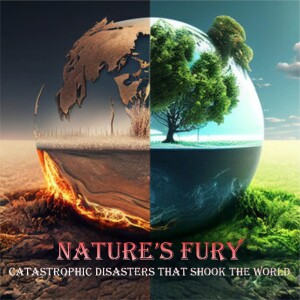
Nature’s Fury: Catastrophic Disasters that Shook the World
This podcast explores the most devastating natural disasters in human history, delving into how these catastrophic events reshaped the world. Each episode presents a deep dive into specific disasters, examining their causes, the immense destruction they caused, and the emotional and social aftermath. Listeners will experience a blend of factual storytelling and powerful, heart-wrenching human experiences to better understand the terrifying power of nature.
Listen on:




Episodes
Friday Sep 26, 2025
Friday Sep 26, 2025
On December 26, 2004, a magnitude 9.1–9.3 undersea earthquake off Sumatra triggered one of the deadliest natural disasters in human history. The resulting tsunami waves, some rising over 100 feet high, devastated coastlines across the Indian Ocean, striking Indonesia, Thailand, Sri Lanka, India, the Maldives, and even reaching East Africa.
In just a few hours, more than 230,000 people lost their lives, with Indonesia suffering the greatest toll. Entire villages were erased, millions displaced, and survivors faced hunger, disease, and trauma. Lacking a tsunami warning system, communities had no chance to escape the surging waters.
The tragedy sparked an unprecedented global response. Billions of dollars in aid flowed in, relief teams mobilized worldwide, and a new Indian Ocean tsunami warning network was established. Communities slowly rebuilt from the ruins, showing extraordinary resilience despite unimaginable loss.
The Boxing Day Tsunami was not only a disaster but also a wake-up call: a reminder of the ocean’s destructive potential, the importance of preparedness, and the unbreakable spirit of humanity in the face of overwhelming tragedy.
Thursday Sep 18, 2025
Thursday Sep 18, 2025
In April 2010, Iceland’s glacier-capped volcano Eyjafjallajökull erupted after nearly two centuries of dormancy. Though modest in size compared to historic eruptions, its impact was global. When molten magma met the glacier’s ice, powerful steam-driven explosions hurled a massive ash cloud into the atmosphere.
Winds carried the ash over Europe, forcing aviation authorities to ground flights for nearly a week. More than 100,000 flights were canceled, affecting an estimated 10 million passengers and costing airlines $2 billion in losses. Airports became shelters for stranded travelers, and global supply chains faltered.
Locally, Iceland faced flooding, ashfall, and damaged farms, though remarkably, no lives were lost. Globally, the event was a wake-up call, showing how even a relatively small eruption could disrupt modern systems of travel and commerce.
The Eyjafjallajökull eruption stands as a reminder that disruption can be as devastating as destruction—and that nature can halt even the busiest skies with little more than an invisible cloud of ash.
Thursday Sep 11, 2025
Thursday Sep 11, 2025
In the summer of 2003, Europe was gripped by a heatwave of unprecedented intensity. For weeks, a high-pressure system trapped hot air over the continent, pushing temperatures beyond 104°F (40°C) in countries like France, Italy, and Spain. The relentless heat turned cities into ovens, strained hospitals, and withered crops across vast regions.
By the time it ended, the heatwave had claimed an estimated 70,000 lives, making it one of the deadliest climate-related disasters in modern history. The elderly, isolated, and vulnerable were hardest hit, many dying quietly in stifling apartments without air conditioning. In France alone, nearly 15,000 people perished in August.
The disaster also left deep environmental and economic scars. Rivers shrank, nuclear plants cut output, and wildfires consumed thousands of square miles of forest. Agriculture suffered devastating losses, costing Europe more than $15 billion.
The 2003 heatwave was a wake-up call, widely linked to climate change, and it forced governments to rethink preparedness. Many countries introduced heatwave response plans, early warning systems, and cooling centers. While later heatwaves would come, none would find Europe as unprepared again.
This episode highlights not only the immense toll of that summer but also the urgent reality that extreme heat, once rare, is becoming the new normal in a warming world.
Wednesday Sep 03, 2025
Wednesday Sep 03, 2025
In August 1992, Hurricane Andrew roared into southern Florida as a Category 5 hurricane with winds over 165 mph, one of the most powerful storms ever to strike the United States. Compact but ferocious, Andrew devastated Homestead and surrounding communities, obliterating neighborhoods, crippling infrastructure, and leaving more than 250,000 people homeless.
The storm claimed 65 lives in Florida and Louisiana and caused an estimated $25 billion in damage, at the time the costliest natural disaster in U.S. history. Relief efforts were hampered by slow government response, exposing weaknesses in FEMA and state agencies, and prompting sweeping reforms in disaster management.
Andrew also reshaped Florida’s future: stricter building codes were enacted, insurance practices overhauled, and emergency planning improved nationwide. Though scars lingered for decades, the disaster highlighted both the destructive force of nature and the resilience of communities determined to rebuild.
Monday Aug 25, 2025
Monday Aug 25, 2025
On March 11, 2011, Japan was struck by a magnitude 9.0 earthquake, the strongest in its recorded history. The quake triggered a massive tsunami with waves over 40 feet high, which devastated coastal communities, claiming over 18,000 lives. But the catastrophe did not end there. The tsunami crippled the Fukushima Daiichi Nuclear Power Plant, flooding its backup generators and disabling critical cooling systems.
Within days, three nuclear reactors melted down, releasing radioactive material into the air and sea. Explosions ripped apart reactor buildings, and over 150,000 residents were evacuated from a wide exclusion zone. The contamination of farmland, fisheries, and homes left many displaced permanently.
Though not as severe as Chernobyl, Fukushima was rated a Level 7 nuclear disaster, shaking global confidence in nuclear energy. It led countries like Germany to begin phasing out nuclear power and forced Japan to overhaul its energy strategy. The cleanup, decontamination, and decommissioning of the plant are expected to take decades.
Despite the tragedy, the disaster revealed stories of courage—most notably the “Fukushima 50”, workers who risked their lives to stabilize the reactors. The Fukushima crisis stands as a stark reminder of how natural and man-made vulnerabilities can collide, creating a disaster far greater than the sum of its parts.
Sunday Aug 17, 2025
Sunday Aug 17, 2025
The Bhola Cyclone struck East Pakistan (now Bangladesh) and India’s West Bengal on November 12, 1970, becoming the deadliest tropical cyclone in recorded history. With winds of 115 mph and a storm surge more than 20 feet high, it wiped out entire villages, drowning hundreds of thousands. The death toll reached an estimated 500,000 people, as survivors faced starvation, disease, and devastation of farmland and livestock.
Beyond the natural destruction, the government’s slow and inadequate relief response fueled anger in East Pakistan, deepening feelings of neglect. The disaster became a political catalyst, contributing to the rise of the Awami League, the Bangladesh Liberation War, and ultimately the creation of Bangladesh in 1971.
The Bhola Cyclone was not only a natural tragedy but also a turning point in history, demonstrating how vulnerable societies can be forever reshaped by the fury of nature.
Saturday Aug 09, 2025
Saturday Aug 09, 2025
On September 1, 1923, a magnitude 7.9 earthquake struck Japan’s Kanto region, devastating Tokyo and Yokohama. But the worst was yet to come. The quake ignited hundreds of fires, fueled by overturned stoves and broken gas lines, which merged into a massive firestorm driven by strong winds.
The inferno consumed entire districts, with temperatures so intense that iron warped and glass melted. One of the greatest tragedies occurred at the Rikugun Honjo Hifukusho army depot, where nearly 38,000 people perished in minutes. Adding to the devastation, a tsunami swept coastal areas, claiming more lives.
By the end, around 140,000 people were dead or missing, and over half a million homes were destroyed. The disaster spurred major reforms in urban planning, building codes, and disaster preparedness, while leaving a permanent mark on Japanese history and collective memory.
Tuesday Jul 29, 2025
Tuesday Jul 29, 2025
On May 18, 1980, Mount St. Helens in Washington State erupted violently, marking one of the most significant volcanic events in U.S. history. Triggered by a 5.1-magnitude earthquake, the eruption caused the largest landslide ever recorded, followed by a lateral blast that flattened over 230 square miles of forest. The explosion launched ash 15 miles into the atmosphere and killed 57 people, including scientists, loggers, and local residents.
This episode revisits the weeks of warning signs leading up to the eruption, the tragic stories of those who stayed behind, and the incredible scientific breakthroughs that followed. It also explores the long-term ecological recovery of the area and how Mount St. Helens became a natural laboratory for understanding volcanic behavior and resilience.
The eruption of Mount St. Helens wasn’t just a display of raw geologic power—it was a turning point in volcanic science, emergency preparedness, and our collective respect for Earth’s dormant giants.
Tuesday Jul 22, 2025
Tuesday Jul 22, 2025
In August 2017, Hurricane Harvey devastated southeastern Texas in one of the most catastrophic natural disasters in U.S. history. Making landfall as a Category 4 storm, Harvey stalled over the region, unleashing over 50 inches of rain and flooding much of Houston. Streets became rivers, homes disappeared under water, and more than 30,000 people were displaced, with at least 107 lives lost.
This episode explores the storm’s slow-moving destruction, the heroism of local residents and volunteers like the “Cajun Navy,” and the overwhelming humanitarian crisis that followed. We dive into the city’s vulnerabilities—unchecked urban development, inadequate drainage systems—and how climate change likely intensified the storm’s effects.
Hurricane Harvey exposed weaknesses, but it also revealed incredible unity, resilience, and compassion. It wasn’t just a weather event—it was a reckoning for how cities prepare for a future shaped by increasingly extreme natural disasters.
Friday Jul 11, 2025
Friday Jul 11, 2025
The 1931 Yellow River Flood was the deadliest natural disaster in human history, killing an estimated 2 to 4 million people. Triggered by extreme weather—including snowmelt, cyclones, and torrential rains—the flood overwhelmed the Yellow, Yangtze, and Huai rivers, submerging an area larger than England and affecting eleven provinces in China.
The initial drowning toll was devastating, but the disaster's true horror unfolded in the months that followed. Famine, disease, and displacement claimed millions more lives. Entire villages were wiped out, and survivors endured starvation, disease outbreaks, and hopeless conditions in overcrowded refugee camps.
Despite its scale, the tragedy remains little known outside China due to limited documentation, political instability, and shifting global attention. This episode sheds light on the immense human cost of environmental mismanagement and unpreparedness—an enduring reminder of nature's silent, creeping devastation.